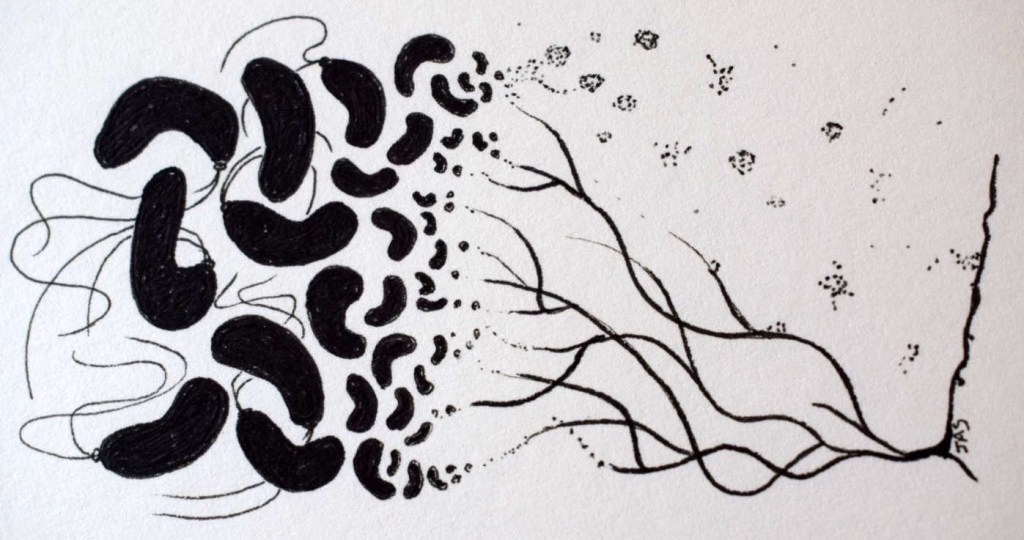
Microbes do not live in isolation. Micro-scale feedbacks between cells, neighboring cells, and the environment scaffold functions that are greater than the sum of individual parts, and that cross scales of biological organization from cells to communities, cross kingdom symbioses, and ecosystems.
How do interactions shape the ecological and evolutionary dynamics of microbes?
Our lab integrates approaches from microbial ecology, cell biology, population genetics and biophysics to address this question.
Current research themes:
Multicellular group formation and the eco-evolutionary dynamics of marine bacteria
Understanding the strategies through which organisms compete is a longstanding question in ecology. While it is well known that group structures like biofilms are ubiquitous in nature, challenges remain in linking the emergent properties of groups to both the ecological dynamics of communities and the evolutionary transitions they may enable.
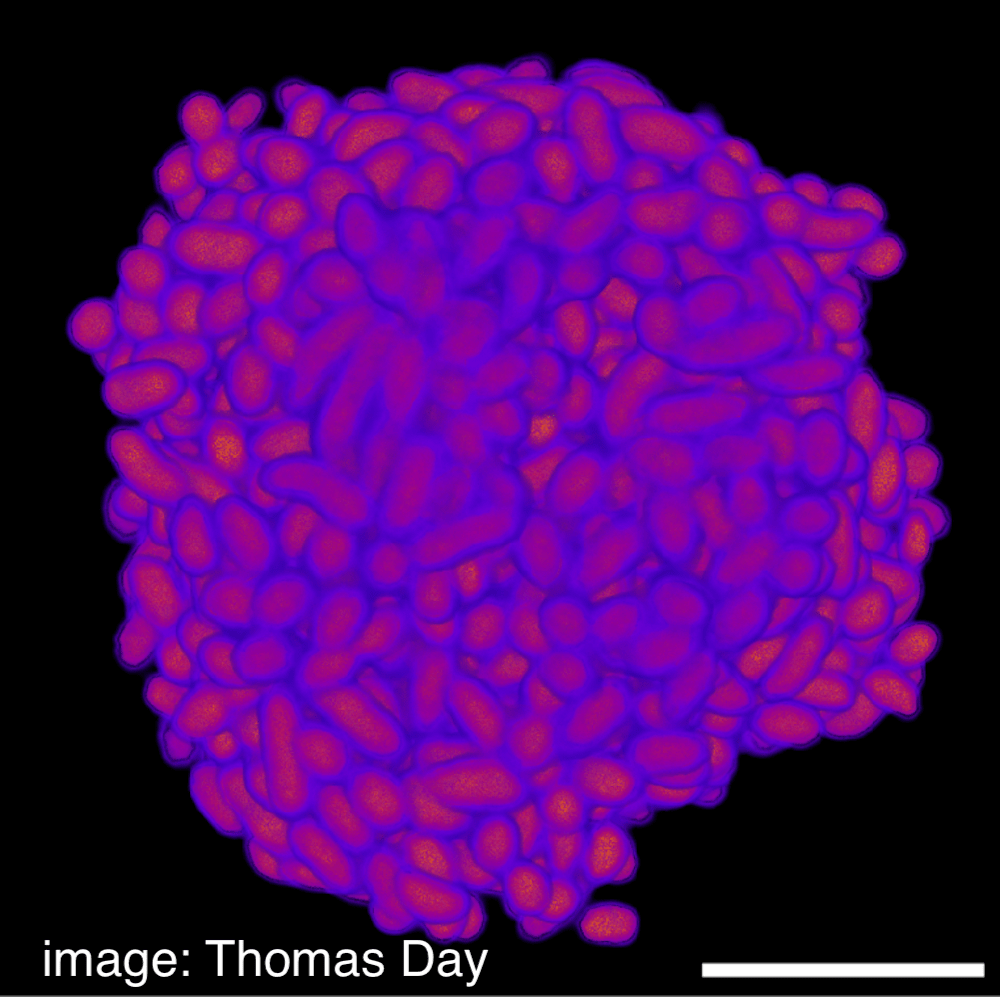
In my postdoctoral work, I demonstrated how forming multicellular groups allows a marine bacterium to extend its environmental range. My research group is building on this work to link the ecological and biophysical dynamics of bacterial groups to the evolution of multicellularity.
- We recently combined theory, experiment and simulation to ask how group behaviors shape the foraging ‘strategies’ of marine bacteria. Our results point to a size-dependent tradeoff between the amount and consistency of resource encountered, that emerges from the physical constraints (Day and Schwartzman BioRxiv 2025).
Kelp-microbe interactions

While they may look like plants, the kelp that form vast underwater forests along our coasts belong to an understudied kingdom of life that evolved multicellularity independently from plants or animals.
Because of its independent evolutionary origin, it’s likely that the mechanisms through which kelp interacts with its environment, and critically, with the microbial world, fundamentally differs from other forms of complex multicellularity. The goal of my group’s research is to decode the hidden language of kelp and microbes. We focus on the biophysical and metabolic processes that influence kelp’s microscopic life stage- which is difficult to observe in the wild but critical for maintaining the resilience of the kelp forest.
- We recently mined kelp metagenomes to assemble draft genomes of microbes associated with the microscopic stages of kelp (Aguirre and Schwartzman, Microbiology Resource Announcements 2024)
Seasonal and spatial dynamics of collective forming bacteria
The productivity of coastal ecosystems is driven by seasonal upwelling and terrestrial export of nutrients, meaning that coastal environments are highly dynamic. It’s not clear how collective behaviors contribute to the ecological structure and function of bacteria in the dynamic coastal ocean. To address this challenge, we are characterizing the seasonal and spatial population structure of bacterial populations sampled over a year and across water column depths in the Southern California Bight (SCB).
- We recently completed a year-long sampling campaign in the SCB to collect ecological populations of the bacterial genus Vibrio. Stay tuned for what we learn!
 Schwartzman Lab